

An agency whose whole model runs on creator volume.
The Viral App builds creator-led growth systems for B2C mobile apps. Publicly, the agency reports 500+ creator partnerships, 1.5B+ views, and work across 30+ app clients, with campaigns behind apps like Cal AI, Invoice Fly, and Hevy.
The model is unusually creator-hungry. A single client engagement recruits somewhere between 5 and 60 creators to post about the app on fresh TikTok and Instagram accounts, producing hundreds to thousands of videos a month for content testing. Multiply that across a roster of app clients, month after month, and recruiting stops being a task and becomes a standing operational load.
“I am really happy with the results we got with UGC Agent. The platform was amazing. We got a ton of Creators and now I feel that it is a key part of our process.”
Volume is the part that breaks.
Most teams can find a handful of good creators. Lucas’s constraint is different: he needs them continuously, in bulk, across categories, for clients who are all running at the same time. That is where manual sourcing stops scaling — not on quality judgment, but on throughput.
“It has been really helpful to get creators especially that nowadays it is really difficult to do it at a high volume. I recommend it for all the agencies or big apps that want to run UGC campaigns at scale.”
That phrase — at a high volume — is the one I care about. It is the difference between a tool that helps you find ten creators for a launch and a tool an agency can lean on every week.
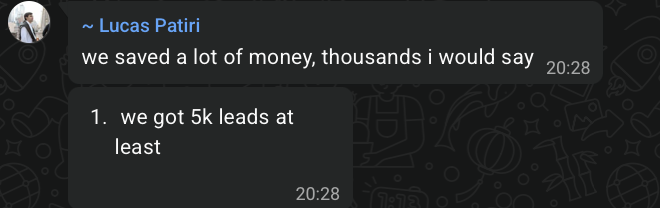
“We got 5k leads at least.”
When I asked Lucas the two questions I ask every customer — how many creators did you find, and did you save money or time — he gave short answers. At least 5,000 creator leads. Thousands of dollars saved.
The last row is agency context rather than a UGC Agent result, and I have kept it labelled that way on purpose. It is there because it explains the shape of the demand: 5,000 leads is not a one-off list for one campaign, it is inventory for a roster.
Why I keep these numbers in context.
Both figures are Lucas’s own estimates, given quickly and in round numbers. “5k leads at least” is his floor, not an audited export count. “Thousands” is his sense of cost avoided against however the agency was sourcing before — not a reconciled line in an accounting system.
Creator leads are also not booked creators. A lead is a starting point for outreach; The Viral App’s own vetting, onboarding, briefing, and negotiation decide which of them ever post. Every one of those steps stayed with the agency.
What I think UGC Agent earns credit for.
The defensible contribution here is supply: enough relevant creator leads, quickly enough and cheaply enough, that a high-throughput agency stopped treating sourcing as its constraint.
- Volume: at least 5,000 creator leads for an agency that recruits continuously across 30+ app clients.
- Cost: thousands of dollars saved against the agency’s previous approach, as reported by Lucas.
- Durability: the result was not a single campaign — sourcing became a standing part of the agency’s process.
- Fit for agencies: Lucas’s own recommendation is aimed at agencies and large apps running UGC at scale.
I do not claim credit for The Viral App’s creator vetting, onboarding, briefs, offers, negotiation, content quality, or any of the view counts and client outcomes the agency reports on its own site.
What I take away from The Viral App’s experience.
Overgrow and UGC World both tested whether sourced leads could start conversations. The Viral App tests something else: whether sourcing survives being run constantly, by a team whose economics depend on it. Five thousand leads later, it is still in the process.
That is what I built UGC Agent to do: discover Instagram and TikTok creators, enrich public profile and contact signals, score fit against the brief, and keep the output ready for review and outreach — at whatever volume the roster demands.
Read the other two side by side: UGC World’s 1,000 creators from a single prompt and Overgrow’s 44% creator reply rate.