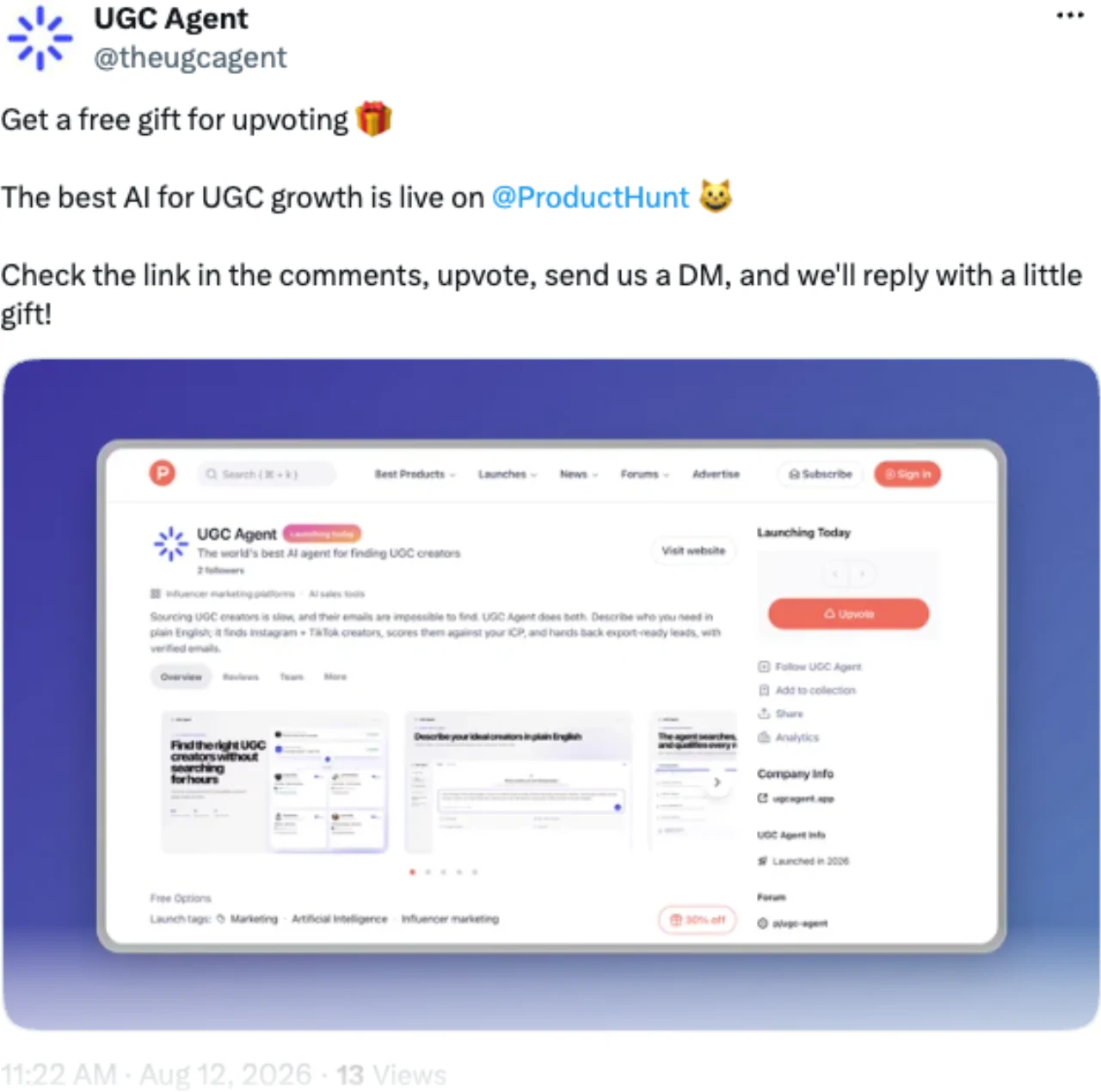
UGC Agent launched on Product Hunt on August 12, 2026. The product let marketers describe the UGC creators they needed in plain English, search Instagram and TikTok profiles, enrich and score candidates, and export outreach-ready leads with available emails. The launch-day gift and PH30 discount have expired. The Product Hunt page and current UGC Agent product remain available.
UGC Agent launched on Product Hunt on August 12, 2026, with a focused promise: describe the creator you need in plain English and get back a structured list of Instagram and TikTok candidates. The product handled discovery, enrichment, first-pass creator-fit scoring, deduplication, and export, including emails where available.
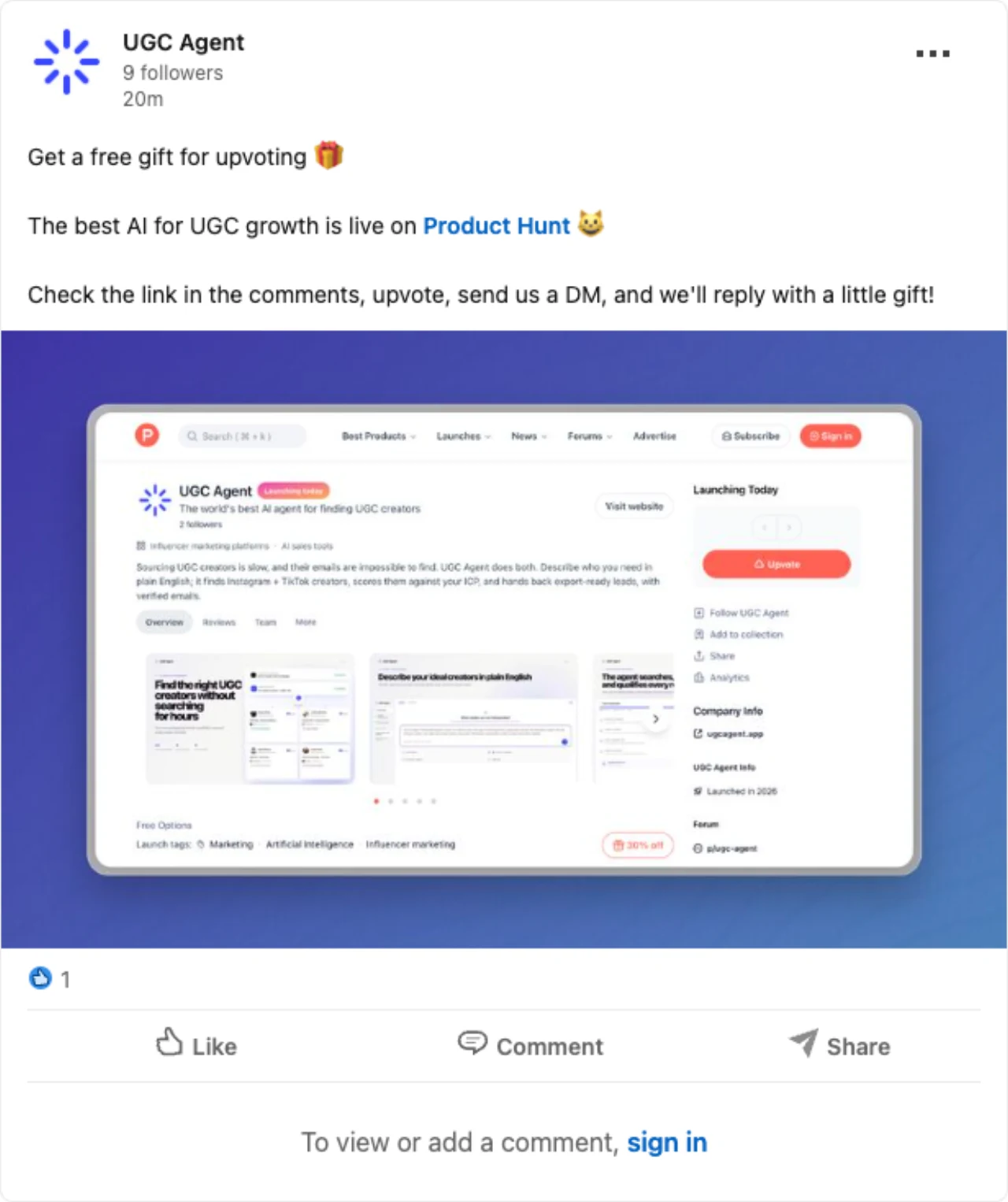
The launch was announced through Beehiiv, X, and LinkedIn. This page serves as the permanent company record after the launch-day promotion ended. It explains what shipped, why creator sourcing was the first problem we chose, and where to find the current product. The original UGC Agent Product Hunt listing remains available on Product Hunt.
UGC Agent launched on Product Hunt on August 12, 2026
UGC Agent went live on Product Hunt on August 12, 2026. The launch introduced a plain-English creator sourcing workflow for teams that needed relevant Instagram and TikTok creators without assembling the list manually across profiles, spreadsheets, and email tools.
Product Hunt gave us one public place to explain the product, share screenshots, and hear from marketers, founders, agencies, and creators. Our newsletter asked existing readers to visit the launch and tell us what they thought.
The launch-day email also included a short discount window and a separate gift offer. Both have expired and are not active on this article. Product Hunt's current launch-sharing guidance says incentives should not reward an upvote, so the permanent version uses a simple visit-or-try CTA instead.
If you are documenting your own launch, keep the historical date and product scope clear. Remove expired pricing or gifts, and do not make an old launch post look like a current promotion.
What UGC Agent did at launch
Plain-English creator search
The user described the product, customer, niche, location, platform, style, and must-have signals in a message. The agent translated that brief into creator searches instead of asking the marketer to express the campaign through a rigid filter set.
Enrichment and creator-fit scoring
Returned profiles were enriched with public signals and evaluated against the request. The score supported a first pass; it did not replace human review or guarantee creator availability, response, content quality, or campaign performance.
Outreach-ready exports with available emails
Qualified records could be organized and exported, including an email when an appropriate public contact was available. UGC Agent never promised that every creator would have an email.
The current UGC Agent platform page shows the broader workflow as it exists now.
Why we built it
Creator sourcing was slow because the work sat across too many small tasks: translate the brief, search profiles, inspect recent content, find a contact route, record the evidence, remove duplicates, and prepare the handoff. UGC Agent combined that first pass into one conversation.
The bottleneck was not a lack of creator profiles. Instagram and TikTok already had the supply. The problem was turning a campaign-specific request into a list another operator could review and contact.
Marketplaces, applications, agencies, referrals, and manual social search remain useful. UGC Agent is for the part where a team needs flexible discovery from public profiles and wants to own the relationship after sourcing.
Our guide to finding UGC creators compares those routes without pretending one model fits every campaign.
What changed after the Product Hunt launch
A launch page freezes one moment. The product did not. Since August 12, UGC Agent has continued to expand the workflow around creator discovery, recurring sourcing, saved leads, creator analysis, campaign research, and handoffs into outreach tools.
The operating principle remains the same: start with a message, let the agent choose the work, and return evidence another marketer can inspect. New features should reduce repeated admin without hiding the decision behind a black box.
For dated product details, use the in-app changelog and current product pages rather than assuming the Product Hunt description reflects every later release.
Where to find UGC Agent now
Visit the original Product Hunt listing for the launch record, use the current UGC Agent website for product details, or start a 3-day free trial, no card required, to test a real creator brief. Free tools are also available when you need a smaller first-pass task.
You can view UGC Agent on Product Hunt and see the product in the context of its launch. For current capabilities, use the website and app.
If you want to test one small task first, the free UGC creator search provides a restricted preview. The full app handles larger creator discovery, enrichment, scoring, organization, and export workflows.
Thank you to everyone who visited, replied, shared feedback, or tried the product during launch week. The useful part of a launch starts after the announcement, when real briefs expose what needs to improve.
How to turn a launch announcement into a durable company record
A permanent launch article should preserve the original date, product scope, screenshots, and public listing while removing expired offers. It should also explain what changed after launch so readers can separate the historical release from the current product.
Start with the exact release date and the job the product performed at that moment. Avoid rewriting history with capabilities that shipped later. A reader should be able to understand why the first version mattered without mistaking the article for the current feature list.
Keep the original visuals. Screenshots and announcement posts show how the product was positioned, what the interface looked like, and which language the team used. They are evidence of the launch, not decoration to replace every time the website changes.
Remove expired codes, countdowns, gifts, and availability claims from the active CTA. If historical context matters, state that the offer ended and give the original window. Do not leave a reader testing a code that was always meant to last seventy-two hours.
Link the primary public record, such as the Product Hunt listing, and the current product page. The launch record answers “what shipped then?” The current page answers “what can I use now?” Keeping both links prevents one page from doing two incompatible jobs.
Add a short post-launch update based on shipped product changes, not retrospective hype. Mention the categories of work that expanded and direct readers to the changelog for dated details. Do not manufacture rankings, traffic, signups, revenue, or user quotes just because launch recaps often include them.
Document what the team learned operationally. Which briefs exposed missing controls? Which handoffs still needed files? Which evidence was hard for reviewers to interpret? A durable launch article becomes more valuable when it shows the product principle that survived the first version.
Review the record on a fixed cadence. Update broken links, add a clear note when an offer expires, and label later capabilities as later additions instead of rewriting launch day. This keeps the page useful without blurring the historical claim. It also gives the product team a trustworthy reference when future announcements describe how the platform evolved.
Connect the announcement to the evergreen learning it introduced. For UGC Agent, that is the shift from browsing profiles toward writing a brief, reviewing evidence, and exporting a workable list. A reader arriving months later may not care about launch-day placement, but can still use that operating idea in a current campaign.
Finally, keep the article in the blog index under its original publication date. Company history should be discoverable alongside guides, data, product updates, and customer stories. The page is not a second launch campaign. It is a reliable record that helps future customers, partners, employees, and search systems understand when the product entered the market and how it has evolved.
Conclusion
The UGC Agent Product Hunt launch put a date and public page around the first version of the product. The core job was clear: turn a plain-English creator brief into an evidence-backed list that a marketer could review and contact. The temporary launch offers are over, but the product and launch record remain. Visit UGC Agent on Product Hunt, use a free creator search, or Start free.
Frequently asked questions
When did UGC Agent launch on Product Hunt?
UGC Agent launched on Product Hunt on August 12, 2026. This article preserves that original date while pointing readers to the current product.
What did UGC Agent do at launch?
It accepted a plain-English creator brief, searched public Instagram and TikTok profiles, enriched and scored candidates, removed duplicates, and prepared export-ready leads with emails where available.
Is the PH30 discount still active?
No. PH30 was a 72-hour launch-day offer and has expired. It is included only as historical context, not as a current promotion.
Does every creator result include an email?
No. UGC Agent includes an email when an appropriate public contact is available. A profile without a usable public email may still require another contact route or manual review.
Can I still visit the Product Hunt page?
Yes. The UGC Agent product page remains available on Product Hunt, while the current UGC Agent website and app contain the latest product information.