UGC Agent started as an AI agent that finds UGC creators. Now it is a data hub for UGC marketing with four parts: the UGC Database of Instagram and TikTok creators with public emails, UGC Brands for studying other brands' UGC programs, Creator Tracking for measuring every video your creators post, and a Creator CRM that runs each deal from sourced to paid. Super Search, the original agent, is still there and feeds the database. Every plan starts with a 3-day free trial. Unlocks, deeper brand data, and more tracked creators scale with the plan.
Most UGC teams run their program across four or five tools and a spreadsheet. Creators come from TikTok scrolling and DMs. Competitor research is a folder of screenshots. Results live in another tab, and the deal status lives in someone's head. Every handoff loses information, and nobody can answer the simple questions quickly: who should we hire, what should they make, is it working, and who still needs to be paid.
UGC Agent began as an AI agent that answered the first question. You described the creators you needed and it searched Instagram and TikTok live. That agent is still here, but it is no longer the whole product. UGC Agent is now a data hub for UGC marketing: one place to find creators, study what other brands run, track what your creators post, and manage every deal. This article explains what changed, what each part does, what each plan includes, and what the product does not do yet.
What changed, and why
UGC Agent moved from a single chat agent to four connected data products: the UGC Database, UGC Brands, Creator Tracking, and the Creator CRM. Super Search, the original agent, now sits inside that hub and keeps adding creators to the database.
The app sidebar tells the story. It now reads UGC Database, Super Search, Creator CRM, UGC Brands, Creator Tracking, and Automations. Each one answers a different question in a UGC program, and the data moves between them. A creator you unlock in the database lands in the CRM. A creator in the CRM can be added to tracking. A creator the agent finds in a search joins the database for the next search.
We made the change because finding creators was never the full job. After the search, the work moved somewhere else: lists went into spreadsheets, competitor accounts were checked by hand, and view counts were copied into reports. The product stopped at the moment the real work started.
There is a second reason. Every agent search verifies creators and their public emails. That work now feeds a database every account can browse, so a creator verified for one brief is ready for the next one without another search. The database grows with every search.
UGC Database: creators who already make UGC
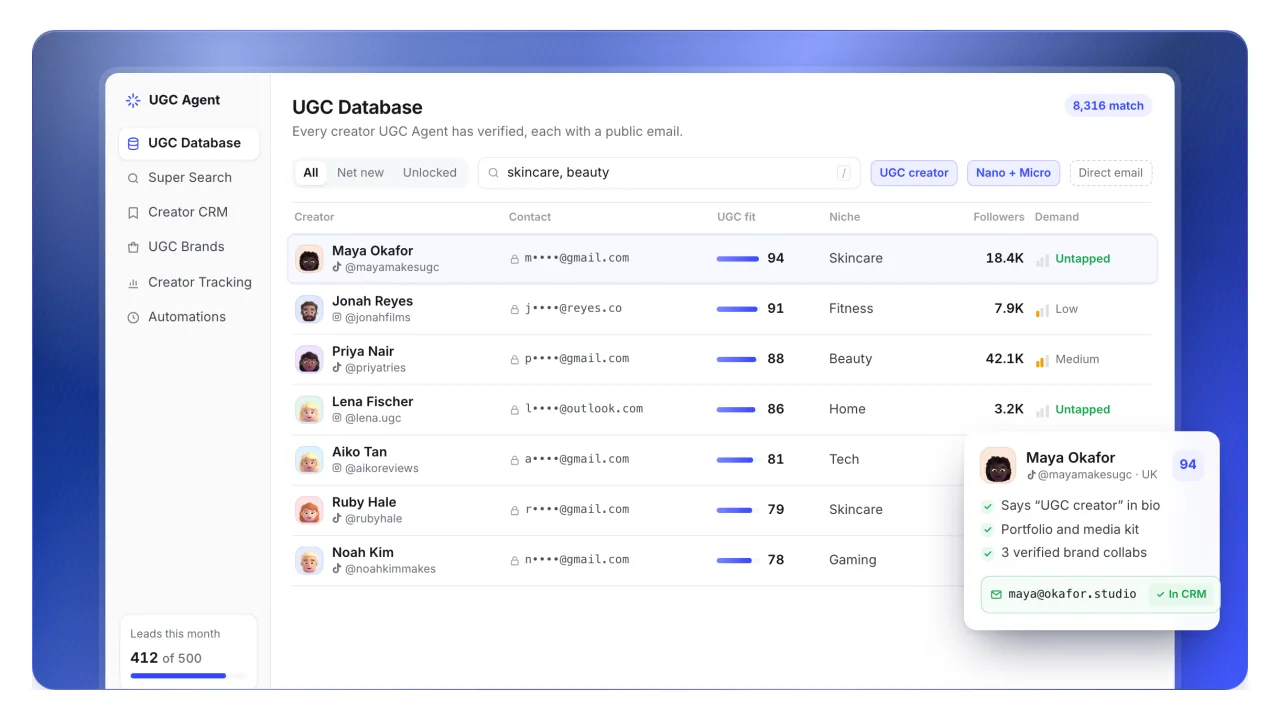
The UGC Database lists every creator UGC Agent has verified, each with a public email. It covers Instagram and TikTok only and holds more than 28,000 creators today. Filtering, sorting and reading a fit score never cost a lead; you spend one only when you unlock a contact.
The filter rail is built around buying signals rather than vanity metrics. You can filter for creators who call themselves UGC creators, have a portfolio, have brand collaboration experience, or have measured engagement, and you can show only untapped creators that no other brand on UGC Agent has unlocked. Every filter option shows a live count, so you know how big a segment is before you commit to it.
The other filters cover the usual brief: platform, niche (include or exclude), follower tiers from Starter under 1K to Macro over 500K or a custom range, country, contact type (direct, own domain, management), gender, profile language, and how recently the creator was added. You can search by name, handle, niche, or bio, and sort by best UGC fit, followers, engagement, recency, or name.
What each row tells you
Each creator shows a UGC fit score from 0 to 100 built from public signals: UGC in the bio, a portfolio, a direct email, and past collaborations. A typical rate column gives a market benchmark for the follower tier, from $50 to $150 for Starter creators up to $1,000 and above for Macro. It is a benchmark, not a quote. A demand column shows how many other brands have unlocked the creator, from Untapped to High, so you know when to expect a busier inbox.
How unlocking works
Emails, bio contacts, and messaging links stay masked until you unlock a creator. One unlock costs one lead from your monthly pool, the same pool Super Search uses, and you can unlock up to 100 creators at once. Creators you already received are free to open again. Every unlocked creator lands in your Creator CRM, and you can export unlocked creators to CSV. Details are on the UGC Database page.
UGC Brands: see who runs UGC and what works
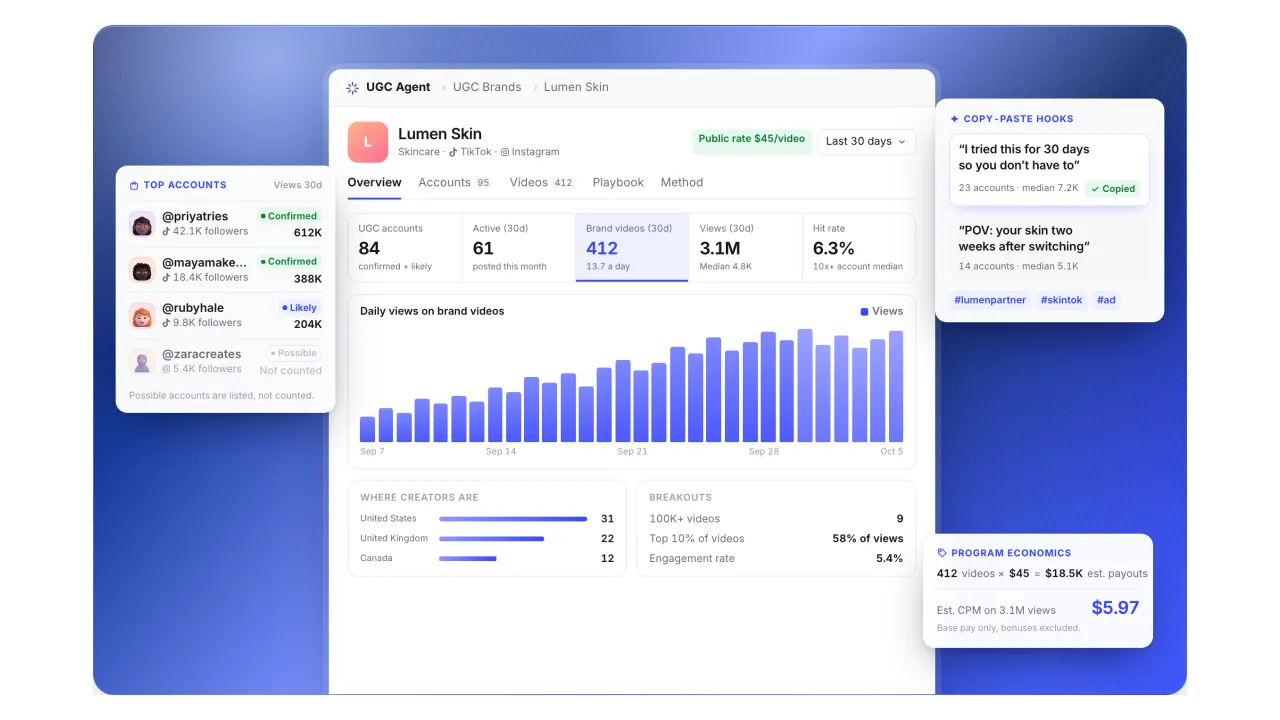
UGC Brands shows brands running UGC programs on TikTok and Instagram: which creator accounts post for them, how much, and how those videos perform. Every attribution comes from public evidence, and the counts are a lower bound.
The brand list shows totals for brands, UGC accounts mapped, brand videos in the last 30 days, and views, with filters for category, platform, program size, creator markets, and whether the brand publishes a per-video rate. Opening a brand gives you five tabs.
Overview covers the program in numbers: UGC accounts, active accounts, brand videos and views over 30 days, median views, hit rate, 100K+ videos, the share of views from the top 10% of videos, engagement rate, daily views, where the creators are, and the top accounts. When the brand publishes a rate, it also shows estimated payouts and an estimated CPM. Accounts lists the creator roster with the evidence for each one. Videos lists the brand videos themselves. Playbook collects copy-paste hooks, hashtags, video length, virality, posting schedule, engagement, and account naming patterns. Method explains how every number was measured and where it came from.
How attribution works
An account is tied to a brand only through public evidence: a program hashtag, a caption template, the account bio, an ad disclosure, a handle pattern, or a platform ad flag. The brand name alone never counts. Each account is marked Confirmed, Likely, or Possible, and the KPIs count only confirmed and likely accounts. That makes every count a lower bound. Payouts and CPM are estimates from the brand's public rate, not reported spend.
Only a handful of brands are mapped at launch. We would rather publish a small set we can explain than a large set we cannot. More brands will be added over time. See the UGC Brands page for the full walkthrough.
Creator Tracking: what every video earned you
Creator Tracking follows every video your creators post. Add creators from the CRM or paste handles and links, then see views, engagement, viral rate, CPM, and payout status per creator, per video, and per campaign.
The Overview tab charts views, engagement, likes, comments, shares, or bookmarks, cumulative or per day, across nine date ranges. Around it sit modules for the most viral videos, virality median, duration analysis, top accounts, engagement breakdown, posting schedule, metrics breakdown, payouts, and video stats. The Videos and Accounts tabs break the same data down further.
Account metrics are written for people who pay creators. You see views gained, average and median views, viral rate (videos at 9x or more of the creator's own median), high viral rate (24x or more), outliers, a 1 to 10 health score, and posting activity against target. Set a fee as flat, per video, or CPM, and tracking calculates spend, CPM, and cost per engagement, with a payout status from Pending to Paid.
Collections are campaigns
Group creators into collections for a campaign, a set of competitors, or inspiration. Each collection can carry match terms that decide which videos count, start and end dates, a CPM goal, a budget, and a posts-per-week target. More on the Creator Tracking page.
One honest note: stats refresh when you open the tab and the data is older than 12 hours, or when you press refresh. There is no scheduled daily refresh yet.
Creator CRM: one pipeline from sourced to paid
Every creator you keep from a search or unlock from the database lands in the Creator CRM. It replaces the creator spreadsheet with a pipeline built for UGC deals, from sourced and contacted through hired, delivered, and paid.
The stages are Sourced, Contacted, Replied, Negotiating, Hired, Creating, Delivered, Paid, and Not a fit. You can work in a table, drag creators across a pipeline board, or clear a follow-ups inbox grouped into overdue, today, next seven days, and later. Custom lists keep campaigns or clients apart.
Each creator record has activity, notes, tasks, profile, and details. You can store a rate per video in five currencies, the number of videos, deal value, a 1 to 5 fit rating, and a phone number, and log every touch as an email, DM, call, or other.
For outreach, the CRM opens a draft in your own mail app from three templates: first outreach, follow-up, and send an offer. Emails are not sent from UGC Agent. If you run sequences, push creators straight to Instantly or Smartlead, or export a CSV. See the Creator CRM page for more.
Super Search and automations are still here
Nothing was taken away from the agent. Super Search still takes a plain-English brief, searches Instagram and TikTok live, checks each profile against the brief, and returns creators with public emails. You can ask for more, refine the brief, or export. It also drafts outreach, researches trends, hooks, and scripts, audits a single account, reviews UGC applications, and answers brand questions such as who has posted videos for a given brand.
The difference is what happens to the results. Creators the agent finds now join the database, and the creators you keep go straight into the CRM. Search is the way to reach creators the database does not have yet, and the database is the way to skip a search when it already does.
Super Search is the part of the product with real customer results behind it. UGC World sourced 1,000 creators from one prompt in about ten minutes and reported zero bounces and 147 positive replies. Overgrow emailed 225 creators and received 99 replies. Those results came from the agent, before the hub existed, and we are not attributing them to the new tabs.
Automations still run recurring creator searches and trend reports, deduplicated and delivered by email. The UGC Agent MCP server still lets Claude, ChatGPT, Cursor, and other clients run searches, and the developer API still covers searches, enrichments, leads, lists, automations, and webhooks.
What each plan includes
Every plan includes the database, the brand list, the CRM and Creator Tracking, and starts with a 3-day free trial; a card is required. Pro adds unlocks and brand overviews. Premium adds full brand pages, more tracking, unlimited automations, and MCP. Ultra removes the lead cap and adds the API.
| Feature | Pro $29 | Premium $59 | Ultra $199 | Enterprise |
|---|---|---|---|---|
| UGC Database browse (masked) | Yes | Yes | Yes | Yes |
| Leads per month (unlocks and Super Search) | 500 | 5,000 | Unlimited | Unlimited |
| UGC Brands list and totals | Yes | Yes | Yes | Yes |
| Brand Overview and Method tabs | Yes | Yes | Yes | Yes |
| Brand Accounts, Videos, Playbook tabs | No | Yes | Yes | Yes |
| Tracked creators | 25 | 100 | 300 | 300 |
| Creator CRM | Yes | Yes | Yes | Yes |
| Automations | 1 | Unlimited | Unlimited | Unlimited |
| MCP | No | Yes | Yes | Yes |
| Developer API | No | No | 100 a day, 2,000 a month | Uncapped |
| Team seats | - | 5 | 10 | 10+ |
One lead is one creator delivered, whether you unlock them in the database or the agent sources them in a search. Every plan starts with a three-day free trial (card required), and annual billing is 20% off. The Method tab opens from Pro so that every brand number you can see can also be explained. Full details are on the pricing page.
What the hub does not do yet
The hub covers Instagram and TikTok only. Brand counts are a lower bound, few brands are mapped at launch, tracking refreshes on open or on demand, and the developer API does not reach the database, brands, or tracking.
We would rather list the gaps than have you find them. The database and brands cover Instagram and TikTok only. There is no YouTube or other platform coverage. The database shows per-creator data. It does not show market-level charts or insights.
UGC Brands starts small, and its numbers undercount on purpose because only confirmed and likely accounts are counted. Payouts and CPM are estimates from a public rate. Creator Tracking does not refresh on a daily schedule, does not have public share links, and does not send Slack or Discord alerts or handle milestone bonuses.
The CRM does not send email from UGC Agent. It opens your mail app or pushes to Instantly and Smartlead. The developer API and MCP work with searches, leads, lists, and automations, but there are no API endpoints for the Database, Brands, or Tracking tabs yet.
Who it is for and how to start
The hub is built for the people who run UGC programs day to day: brand marketers who hire creators for paid social, agencies running creator pipelines for several clients, app teams that need a steady rotation of creators, and freelance UGC operators. If your program lives across a creator spreadsheet, a folder of competitor screenshots, and a separate results report, the hub replaces all three.
A simple first session takes four steps. Open the UGC Database and filter for your niche, platform, and follower tier with the UGC creator signal switched on. Open a mapped brand in UGC Brands to see how its program is built: the Overview opens from Pro and the Playbook of hooks and formats from Premium. Unlock a few creators so they land in the CRM (unlocks start on Pro). Then add your current creators to tracking so the next campaign has a baseline.
If the database does not have the creators you need yet, ask Super Search in plain English. The creators it finds join the database, and the ones you keep land in your CRM.
Conclusion
UGC Agent is no longer only an agent that finds creators. It is a data hub for UGC marketing: a database of creators who already make UGC, a view into other brands' UGC programs, tracking for every video your creators post, and a CRM that follows each deal to payment. The fastest way to judge it is to start the 3-day free trial, open the database and filter for your next brief. Start free, or compare plans on the pricing page.
Frequently asked questions
What is the UGC Agent data hub?
It is UGC Agent's new structure: four connected products for UGC marketing. The UGC Database finds creators, UGC Brands shows other brands' UGC programs, Creator Tracking measures every video your creators post, and the Creator CRM runs each deal. Super Search, the original AI agent, is still included.
Can I try the UGC Database before I pay?
Yes. Every plan starts with a 3-day free trial; a card is required, and you can cancel before it ends. Contacts stay masked until you unlock them. Unlocking a creator's email costs one lead from your monthly pool and needs Pro or above: 500 leads a month on Pro, 5,000 on Premium, and unlimited on Ultra and Enterprise.
Which platforms does UGC Agent cover?
Instagram and TikTok only. The database, UGC Brands, Creator Tracking, and Super Search all work with those two platforms, and every creator in the database has a public email.
How accurate are the numbers in UGC Brands?
Accounts are attributed to a brand only from public evidence such as a program hashtag, caption template, bio, ad disclosure, handle pattern, or platform ad flag, never the brand name alone. Only confirmed and likely accounts are counted, so counts are a lower bound, and payouts and CPM are estimates from the brand's public rate.
How often does Creator Tracking update?
Stats refresh when you open the tab and the data is older than 12 hours, or when you press refresh. There is no automatic daily refresh yet. Pro tracks 25 creators, Premium 100, and Ultra and Enterprise 300.