
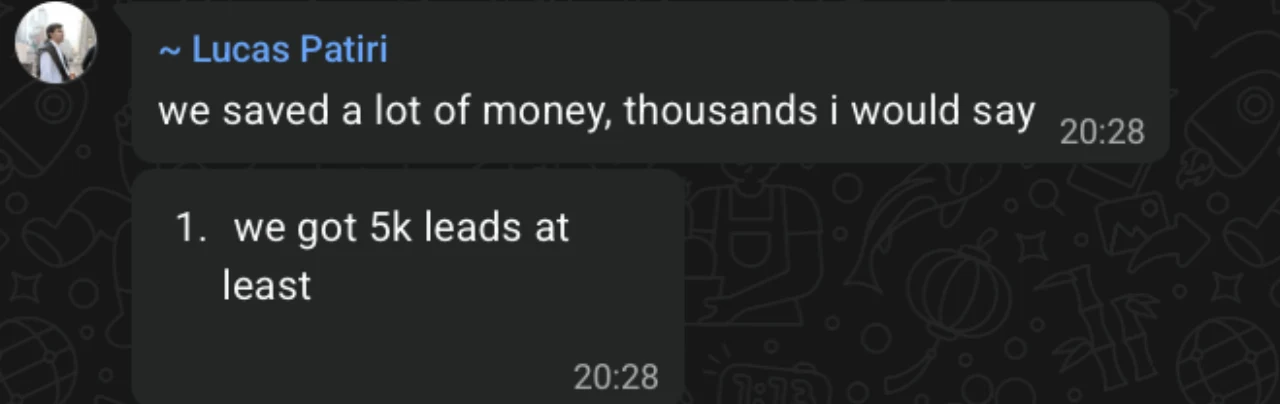
The Viral App, a UGC and influencer marketing agency for B2C mobile apps, reports sourcing at least 5,000 creator leads with UGC Agent across work for more than 30 clients. Co-founder Lucas Patiri also estimated that the agency saved thousands of dollars. Both numbers are customer estimates, not audited exports or reconciled ROI, and the agency still handled every step after sourcing.
A UGC creator sourcing agency does not run one search and stop. New app clients, formats, locations, audiences, and production calendars create continuous demand for creators. The Viral App works exclusively with B2C mobile apps and may need between five and 60 creators producing content each month for an engagement.
In our August 14, 2026 customer announcement, co-founder Lucas Patiri reported that the agency had sourced at least 5,000 leads and saved thousands of dollars with UGC Agent. This article preserves his wording and makes the limits explicit. The creator count is a floor estimate. The savings figure is not audited ROI.
What did The Viral App report?
The Viral App reported sourcing at least 5,000 creator leads with UGC Agent. Co-founder Lucas Patiri said creator sourcing had become a key part of the agency's process and estimated that the team had saved thousands of dollars.
Lucas described both figures as round estimates: “we got 5k leads at least” and “we saved a lot of money, thousands i would say.” We are keeping that uncertainty in the published result instead of converting it into a precise count or calculated return.
The useful evidence is operational. The agency continued using creator sourcing across a large client base rather than for one campaign. The customer connected the product to an ongoing process, not a single list.
The result does not say that 5,000 leads became booked creators or finished videos. It describes the top of the agency's pipeline.
The creator volume behind more than 30 app clients
The Viral App runs UGC and influencer campaigns for B2C mobile apps. Each client can require a different creator persona, platform, language, location, content angle, and production cadence. A fixed roster eventually reaches its limit.
At the low end of Lucas's range, an engagement might need five creators a month. At the high end, it might need 60. Multiply that operating range across more than 30 clients and sourcing becomes a recurring production input rather than an occasional research task.
App UGC also spans different jobs: direct-to-camera testimonials, screen-recorded walkthroughs, problem-solution videos, routines, reaction formats, and paid social variations. The app UGC creator guide explains how those content jobs change the search.
Why continuous sourcing is the difficult part
Most teams can find a handful of usable creators once. The harder operating problem is finding new, relevant, contactable creators every month without repeating the same profiles or lowering the review standard as volume increases.
High-volume sourcing creates small costs everywhere: writing searches, opening profiles, checking recent work, locating contacts, recording evidence, normalizing handles, removing duplicates, and moving the list into review.
Those steps are manageable for ten profiles. Repeating them across clients and months is where the process slows down. A sourcing system earns its place when it keeps the input consistent enough for the rest of the agency workflow.
The answer is not to automate every decision. Use software for discovery, enrichment, evidence capture, and deduplication. Keep campaign fit, creator communication, rates, rights, content judgment, and client approval with people.
How to interpret the reported savings
“Thousands of dollars saved” is Lucas Patiri's estimate of cost avoided. It is not a reconciled ROI figure, a guaranteed saving, or a claim that UGC Agent replaced the agency's campaign team. The agency still performed every downstream operating task.
A customer estimate, not audited ROI
We do not have the agency's historical staffing model, software stack, contractor invoices, internal time records, or reconciled finance data. Without those inputs, the estimate should stay an estimate.
What the agency still handled
The Viral App reviewed creators, ran outreach, negotiated scope and rates, onboarded talent, prepared briefs, managed production, handled revisions, and delivered work to clients. Sourcing reduced one input. It did not perform the entire service.
If you want to estimate your own campaign economics, use the UGC campaign ROI calculator with your actual costs and assumptions rather than importing someone else's savings estimate.
What high-volume UGC teams can learn
Define a repeatable handoff between sourcing and campaign operations. Every record should carry the profile, evidence, contact route, client or brief, review status, exclusions, and next action. Volume is useful only when another operator can understand and continue the work.
Start with a client-specific brief. Shared agency preferences can cover recurring rules, but they should not erase differences between a finance app, a wellness app, and a social product.
Use three review states: pass, manual review, and reject. Record why a creator entered each state. This lets the next sourcing run learn from the campaign instead of rebuilding the same assumptions.
The agency creator sourcing page covers multi-client workflows, while the UGC campaign guide picks up after the shortlist. Read the complete The Viral App customer story for the attributed screenshots and original context.
Build a high-volume agency sourcing system
A high-volume agency needs one shared record that connects each creator to the client brief, evidence, review status, outreach history, commercial terms, production stage, and exclusion rules. More leads without this operating layer create more confusion.
Create a client and campaign identifier before sourcing begins. Attach it to the search, saved list, export, outreach campaign, brief, and production record. This prevents a creator found for one app from appearing in another client's queue without a new fit review.
Standardize the fields that every client needs: profile URL, platform, handle, location evidence, language, recent work sample, email source, creator type, reviewer, review date, fit notes, risk notes, and next action. Add campaign-specific fields only when they change the decision.
Define ownership at every handoff. The sourcing operator owns evidence and initial fit. The outreach owner controls messages, suppression, and replies. The campaign manager owns scope, rates, contracts, and production. The client owner manages approvals and reporting. One person can hold several roles, but the status still needs a named owner.
Use explicit queues for manual review and exceptions. An uncertain manager email, unclear location, possible child involvement, regulated claim, or conflicting brand relationship should not be forced into pass or reject. Route it to someone with the right context.
Track capacity by stage. If sourcing creates 500 leads but outreach can contact only 100, the system has not solved the bottleneck. If outreach creates 50 positive replies but campaign managers can onboard ten creators, adding more discovery volume may make the service slower.
Close every campaign with reusable learning. Save approved creators, record why content was accepted or rejected, update do-not-contact and conflict lists, and archive rights and permission dates. The next brief should begin with the agency's accumulated evidence, not an empty spreadsheet.
Plan capacity beside lead volume. Estimate how many profiles one reviewer can assess, how many active conversations one manager can handle, and how much production the team can support. Size each batch to the narrowest stage. A larger list is not progress when it creates an unread queue or delays replies to interested creators.
Preserve client separation as the system grows. Use distinct briefs, campaigns, exclusions, and reports so one client's creator history does not silently alter another client's outreach. Shared operating standards help, but compensation, usage rights, conflicts, and brand suitability still belong to each campaign.
Review the full funnel with the client after delivery. Show which creators were sourced, reviewed, contacted, interested, contracted, producing, approved, and retained for future work. Keep customer estimates and time savings labeled. This turns a large sourcing number into an operating record the agency can improve without overstating what discovery alone achieved.
Conclusion
The Viral App's result is a scale story with careful boundaries: at least 5,000 creator leads and an estimated thousands of dollars saved across work for more than 30 app clients. The value is not the size of one export. It is that sourcing became repeatable enough to support an ongoing agency process. Keep customer estimates labeled, keep every lead separate from a booked creator, and keep human ownership after discovery. Read the full customer story or Start free.
Frequently asked questions
How many creator leads did The Viral App source?
Co-founder Lucas Patiri reported that the agency sourced at least 5,000 creator leads with UGC Agent. He described 5,000 as a floor estimate rather than an audited export count.
How much money did The Viral App save?
Lucas estimated that the agency saved thousands of dollars. The figure is a customer estimate of cost avoided, not reconciled ROI or a guaranteed saving.
How many clients does The Viral App serve?
The customer story states that The Viral App runs UGC and influencer campaigns across more than 30 B2C mobile app clients.
Did UGC Agent manage the campaigns?
No. UGC Agent supported creator sourcing. The Viral App still owned vetting, outreach, negotiation, onboarding, briefs, production, revisions, and client delivery.
Does 5,000 leads mean 5,000 booked creators?
No. A creator lead is a profile at the start of the process. It still needs review, contact, interest, commercial agreement, production, and approval before it becomes campaign output.