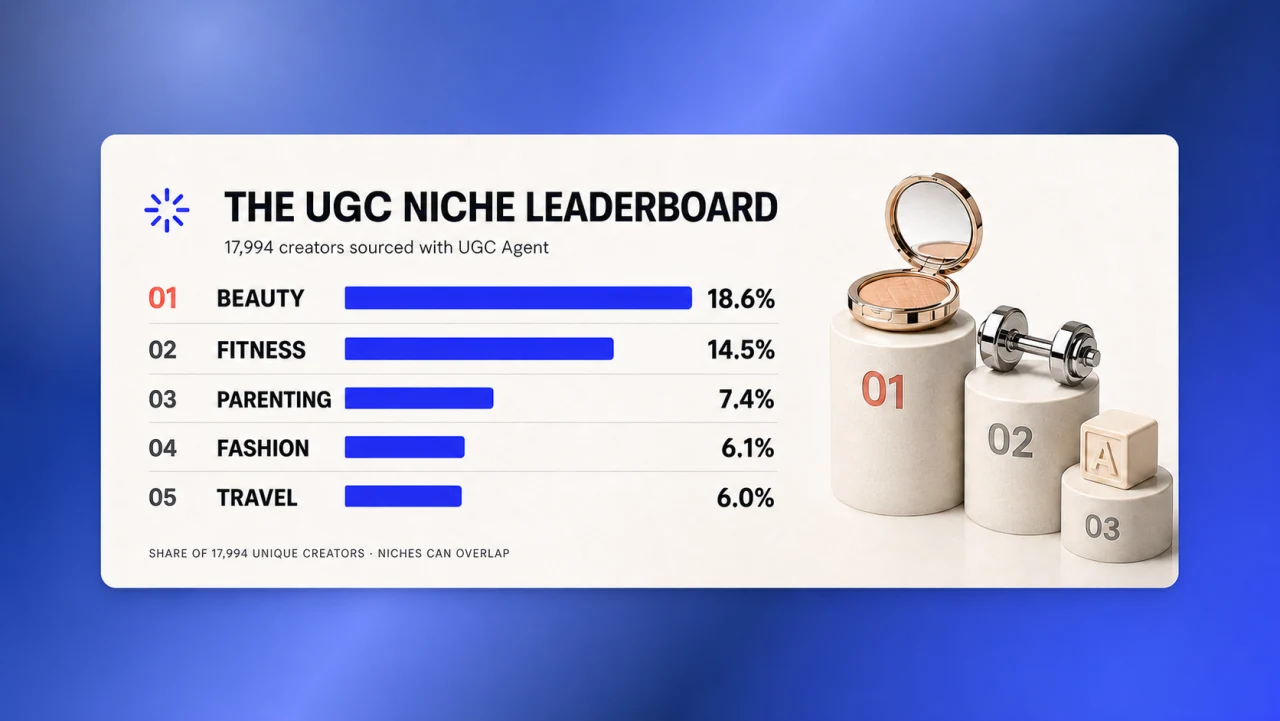
Beauty was the most common niche in 17,994 unique creator profiles sourced with UGC Agent, appearing across 18.6% of the dataset. Fitness followed at 14.5%, then parenting at 7.4%, fashion at 6.1%, and travel at 6.0%. Profiles can belong to more than one niche, so the percentages overlap and do not sum to 100%. This is sourcing data, not performance or earnings data.
The most popular UGC niches in UGC Agent's August 2026 sourcing data were beauty, fitness, parenting, fashion, and travel. Beauty appeared across 18.6% of 17,994 unique creator profiles, while fitness appeared across 14.5%. The next three categories were much closer together.
The dataset came from creators sourced through UGC Agent and was deduplicated by platform and handle. It contains no customer, user, or creator-level reporting. A creator can belong to several niches, so the shares overlap. The original August 25 announcement shared the top five. This article adds methodology, outside context, and practical limits for brand teams.
What are the most popular UGC niches in the dataset?
Beauty led at 18.6% of unique sourced profiles, followed by fitness at 14.5%, parenting at 7.4%, fashion at 6.1%, and travel at 6.0%. Because one creator can carry several niche labels, these shares describe prevalence, not exclusive categories.
| Rank | UGC niche | Share of 17,994 creators |
|---|---|---|
| 1 | Beauty | 18.6% |
| 2 | Fitness | 14.5% |
| 3 | Parenting | 7.4% |
| 4 | Fashion | 6.1% |
| 5 | Travel | 6.0% |
Beauty and fitness form the clear leading pair in this dataset. Parenting sits in third at roughly half the fitness share. Fashion and travel are separated by only 0.1 percentage points.
The rankings answer one narrow question: which canonical niche labels appeared most often among creators sourced through UGC Agent. They do not rank creator quality, brand demand, campaign spend, pay, availability, or content performance.
How the 17,994-creator dataset was prepared
The analysis began with 20,655 kept lead records. Records were deduplicated by platform and handle, producing 17,994 unique sourced creators. The analysis then used UGC Agent's canonical niche taxonomy to count profiles associated with each category.
Deduplication by platform and handle
A creator can appear in multiple searches. Deduplication prevents repeat discovery from inflating a niche simply because the same profile matched several user briefs.
Canonical niche taxonomy
Canonical labels group related profile signals into consistent categories. They reduce spelling and wording variation, but any taxonomy compresses nuance. A wellness creator can also be a parent, traveler, fitness instructor, or beauty reviewer.
Why percentages can overlap
Niche membership is multi-label. The denominator for every percentage is all 17,994 unique creators, while the numerator is the number associated with that niche. Do not add the shares and expect 100%.
Beauty and fitness lead the top five UGC niches
Beauty appeared across 18.6% of unique sourced creator profiles and fitness across 14.5%. Both categories support visible product use, routines, demonstrations, tutorials, and personal context, but the dataset does not show why a profile was sourced or whether its content performed.
Beauty briefs often need skincare routines, makeup application, texture close-ups, before-and-after formats, ingredient education, or product demonstrations. The beauty and wellness creator guide explains how to turn those content jobs into search criteria.
Fitness spans activewear, equipment, apps, workouts, recovery, routines, and health-adjacent products. Category fit alone is not enough. Safety, claims, qualifications, product access, and the exact customer persona can matter more than a generic fitness label. Use the fitness and health creator guide for that review.
External datasets use different definitions but provide useful context. Upfluence's Q1 2026 creator-economy study analyzed 48,107 applications across 2,605 marketplace campaigns and found distinct platform and demographic patterns across beauty, fashion, fitness, and other industries. It should not be compared numerically with our sourced-profile data.
Parenting, fashion, and travel form the next tier
Parenting appeared across 7.4% of sourced profiles. That category can overlap with food, home, beauty, wellness, education, travel, and family apps. Brands should specify who appears on camera, whether children are involved, what privacy rules apply, and what claims or sensitive topics are prohibited.
Fashion reached 6.1%. Try-ons, hauls, styling, fit notes, accessories, gifting, and seasonal launches all need different creator evidence. The fashion UGC creator guide separates those content jobs.
Travel followed at 6.0%, only 0.1 percentage points behind fashion. Travel briefs often depend on location, availability, transport, property access, filming permission, weather, and production dates. Use the travel and hospitality creator guide to capture those constraints before search.
What brands should do with niche-level data
Use niche prevalence to understand the available creator pool and refine a brief, not to predict content performance. A useful search still needs the product, customer, region, platform, format, must-have evidence, contact requirements, and clear exclusions.
Use niche share as sourcing context
A larger category may provide more candidate variety, but it can also produce more noise. Narrow the search with product behavior, customer persona, creative format, and demonstrated content signals.
Do not treat prevalence as performance proof
The dataset does not contain campaign spend, creator pay, ad results, revenue, booking rate, or content approval. A common niche is not automatically a better niche for your brand.
CreatorIQ's 2026 State of Creator Marketing report discusses broader investment and measurement pressure across creator marketing. That market context explains why teams care about creator supply, but it does not validate performance for any niche in this dataset.
Limits of the most popular UGC niches dataset
The analysis covers creators sourced through UGC Agent, not every UGC creator on Instagram or TikTok. Search behavior, user briefs, platform coverage, taxonomy choices, profile availability, and the August 2026 time window all shape the result.
The dataset is not a random sample of the global creator population. Users asked for specific creators, and those requests influence which niches appear. The result describes sourced profiles, not underlying platform supply.
Profile labels can also change. Creators move categories, update bios, add services, change platforms, and produce new formats. Treat the leaderboard as a dated snapshot.
No user, customer, or creator-level information is included in the published analysis. The useful next step is not to chase the number-one niche. It is to search creators in the niche your campaign actually needs.
Turn UGC niche data into a campaign brief
Use niche data to choose the vocabulary and constraints for discovery, then define the actual content job. The brief still needs a customer, product action, platform, region, format, evidence standard, contact route, exclusions, and commercial context.
Start with the category, then narrow to the product behavior. “Beauty creator” is broad. “US skincare creator who demonstrates texture and application on camera, speaks to sensitive-skin customers, and has recent product tutorials” gives the search a usable job.
Add the customer persona separately from the creator niche. A fitness creator can speak to first-time gym members, endurance athletes, parents training at home, or people using a recovery app. The same category label can hide very different audiences.
Specify the content format and proof. A routine, direct-to-camera review, product demonstration, tutorial, screen recording, try-on, recipe, or property walkthrough requires different public evidence. Ask the search to find creators who already show the relevant production behavior.
Write must-have constraints and exclusions. Location, language, age, product access, travel availability, child involvement, regulated claims, conflicting categories, or a public business contact can change whether a profile is usable.
Choose a result count based on review capacity. A common niche may produce a larger pool, but volume should not weaken the evidence standard. A less common niche may require broader language, adjacent categories, manual review, or several discovery channels.
Record which criteria created the most rejections. If “beauty” returns too many makeup creators for a skincare brief, add product-action evidence. If a travel search returns aspirational pages without location access, require recent destination or property content. The niche label starts the search. Rejection evidence makes the next one better.
Conclusion
Beauty led the most popular UGC niches in this 17,994-creator dataset, followed by fitness, parenting, fashion, and travel. The ranking is a sourcing snapshot with overlapping labels, not a market census or performance table. Use it to understand category prevalence, then return to the campaign brief: product, customer, region, platform, format, evidence, contact route, and exclusions. Search one real niche with the free creator tool, or Start free for the full workflow.
Frequently asked questions
What was the most popular UGC niche?
Beauty was the most common niche in the dataset, appearing across 18.6% of 17,994 unique sourced creator profiles.
What were the top five UGC niches?
The top five were beauty at 18.6%, fitness at 14.5%, parenting at 7.4%, fashion at 6.1%, and travel at 6.0%.
Why do the niche percentages overlap?
Creators can belong to more than one niche. Each share uses all 17,994 unique creators as the denominator, so the percentages are not exclusive and do not sum to 100%.
Does the ranking show which UGC niche pays the most?
No. The dataset contains sourced creator profiles, not rates, campaign spend, bookings, revenue, or creator earnings.
Does the dataset represent every UGC creator?
No. It represents creators sourced through UGC Agent during the analyzed period. User briefs, product coverage, taxonomy, and platform availability all influence the result.