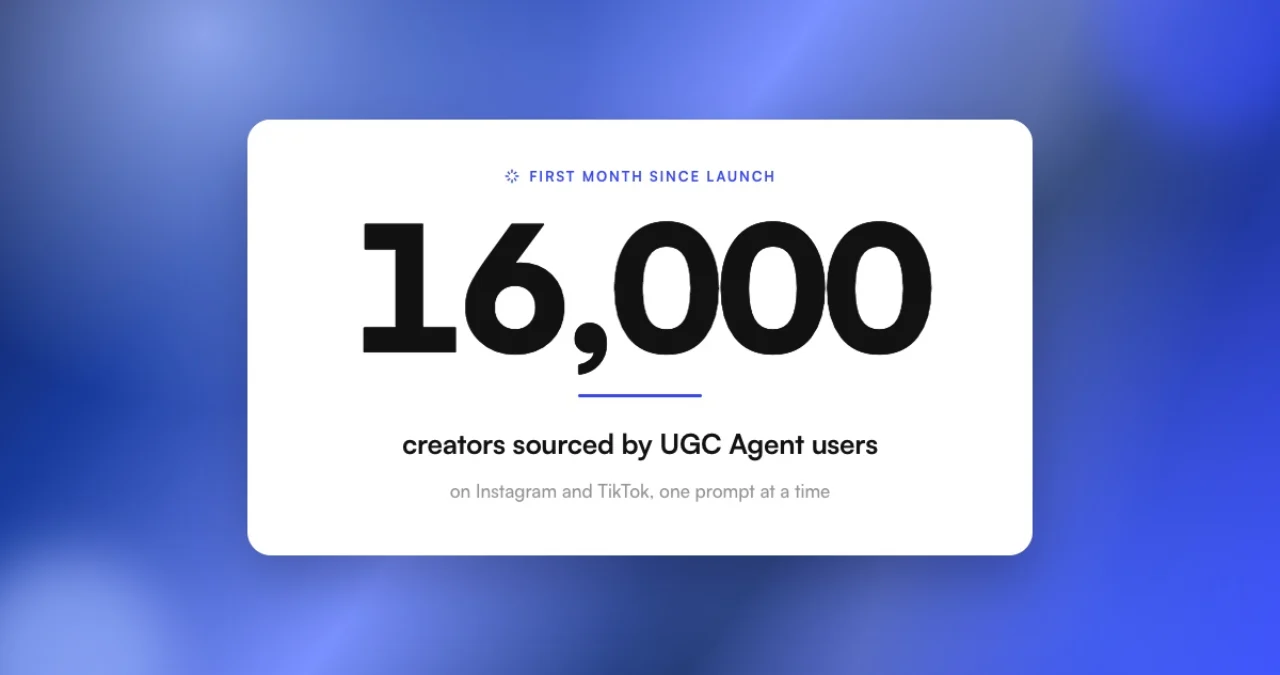
UGC Agent users sourced 16,000 creators across Instagram and TikTok during the first month after launch. The count represents creators surfaced and kept through user searches. It does not represent 16,000 bookings, contracts, collaborations, or delivered assets. The milestone shows the volume of discovery work moving through the product, while every later decision still belongs to the campaign team.
UGC creator sourcing became measurable in UGC Agent's first month: users surfaced and kept 16,000 creators across Instagram and TikTok. We published the number on August 19, 2026 because it showed how much discovery work teams were trying to complete when the search started with a campaign-specific message.
The milestone needs a precise definition. It is not 16,000 hired creators or completed collaborations. It counts creators that users' searches found and retained in the product during the first month. The original announcement made that limit explicit. This article keeps the same boundary and explains what the number says about the workflow.
UGC Agent users sourced 16,000 creators in the first month
During the first month after launch, UGC Agent users surfaced and kept 16,000 creator records across Instagram and TikTok searches. The searches began from the users' own briefs, criteria, and campaign needs.
We say users sourced the creators because they supplied the intent. One team might need small US skincare creators with public emails. Another might need UK app creators who record screen walkthroughs. The product executed the discovery work, but the request and decision came from the marketer.
The count aggregates many different searches. It should not be read as one campaign, one customer, or one uniform creator category.
It is a product-usage milestone, not a market-size estimate. The number describes activity inside UGC Agent during a defined first-month window.
What the 16,000 count includes
The count includes creator profiles surfaced and kept through user searches on Instagram and TikTok. Keeping a creator means the record passed enough of the active search process to remain in the result set.
Different searches may apply different requirements. Niche, location, language, follower range, public email, portfolio signals, recent content, and campaign fit can all affect which creators are kept.
The public creator-fit scoring methodology explains the first-pass signals and limitations. A score organizes review. It does not establish availability, price, safety, or final campaign fit.
What the milestone does not mean
The 16,000 figure does not mean 16,000 creators were contacted, interested, contracted, paid, or booked. It does not measure delivered content, ad performance, revenue, or campaign ROI. A creator lead remains the start of the operating process.
Not 16,000 booked collaborations
Discovery identifies a candidate. The team still needs to review recent work, confirm the contact route, send a clear opportunity, compare quotes, agree on usage rights, contract the creator, and manage production.
Not a campaign-performance claim
A sourced creator count cannot tell you whether the final asset will be approved or perform in paid social. Creative quality and performance need separate evidence after production and distribution.
Keeping those stages separate prevents a vanity metric from replacing the business result. It also gives the team a clearer place to diagnose the workflow when something stalls.
Why sourcing volume still matters
Volume matters when it reflects real briefs and supports a consistent review queue. Many teams limit a campaign because manually finding the next 50 suitable profiles takes too long, not because they lack creative ideas.
Broader market research points in the same operational direction without validating our number. CreatorIQ's 2026 Creator-Powered Funnel release says creator content accounted for 44% of paid media creative among 100 surveyed marketing leaders. That is a separate external survey with a different population and method.
The inference is modest: when teams use more creator content, they need a repeatable way to find and review more creators. Our first-month count shows that users brought that need into UGC Agent.
What happens after a creator is found
After discovery, review the profile against the live brief, verify public evidence and contact ownership, classify the result, send a clear paid opportunity, agree on scope and rights, and track the creator through production and approval.
Use the UGC creator screening checklist before outreach. It separates identity, content execution, campaign fit, contact quality, and risk instead of relying on one blended impression.
Then use the creator outreach guide to identify the brand, explain why the creator fits, state the paid or gifted context, summarize the likely scope, and ask for one clear next step.
When you need a smaller first pass, the free UGC creator search can test the brief. The full app is for repeated discovery, enrichment, scoring, organization, and export.
What the next month needs from the creator pipeline
The next milestone should not simply be a larger top-line count. Better sourcing means fewer repeated profiles, clearer evidence, stronger contact classification, faster human review, and cleaner handoffs into outreach.
Teams can improve the input by writing narrower briefs and recording why profiles pass or fail. Product changes can improve the execution by preserving preferences, exclusions, history, and downstream integrations.
Thank you to the users who trusted a new product with real creator briefs during the first month. Those searches created the feedback loop that matters more than a launch-week spike.
How to measure creator sourcing beyond volume
Pair sourced-creator volume with qualification, evidence, contact, review, and handoff metrics. A smaller list with a high review pass rate and clear contact ownership can be more useful than a larger list that creates manual cleanup.
Measure unique profiles, not repeated appearances across searches. Deduplicate by platform and handle, then preserve the search or campaign relationships separately. This shows both the size of the creator pool and how often the same profile matched different briefs.
Track first-pass qualification rate. Divide the creators retained after review by the number inspected. A very low rate can indicate vague criteria, weak evidence, the wrong discovery channel, or a category with limited public signals.
Track evidence completeness. Record whether each lead has a recent relevant post, location or language evidence when required, a clear profile identity, and an attributable contact route. Missing fields should be unknown, not silently treated as a pass.
Track contactability by type. Separate public personal emails, creator-owned domains, likely manager or agency contacts, unknown business addresses, and profiles that prefer DMs. A single “has email” rate hides meaningful differences in who controls the inbox.
Measure human review time and backlog age. Faster discovery has little value if records wait three weeks before anyone inspects them. Use the age of the oldest unreviewed lead and the median time from discovery to decision as operating signals.
Measure clean handoffs. Count how many approved records entered Saved Leads, an export, an outreach campaign, or another assigned destination without duplication or missing fields. The sourcing deliverable is complete only when the next operator can continue the work.
Keep reply, quote, booking, production, approval, and performance metrics downstream. Connect them to the original source when possible, but do not blend them into the definition of a sourced creator. This gives the team a full funnel while preserving the meaning of each stage.
Add time and cost to the funnel. Measure minutes spent writing the brief, reviewing profiles, correcting contacts, handling replies, negotiating, and managing production. A workflow can improve while the final creator count stays flat if it reduces manual review or helps the team reach a confident decision sooner.
Pair the stage counts with a small quality review. Sample approved and rejected profiles, compare the evidence, and ask whether another teammate would make the same decision. Consistent judgment matters because a high pass rate can indicate either strong sourcing or criteria that are too loose.
Report the milestone and the outcome separately. Discovery volume shows product activity. Contracts, delivered assets, approval rate, content performance, and revenue answer different questions and usually arrive later. Keeping those measures distinct makes reporting more honest and the next decision more useful.
Conclusion
The first-month milestone is intentionally narrow: UGC Agent users sourced 16,000 creators across Instagram and TikTok. It measures discovery activity, not booked collaborations or campaign performance. The useful next step is to make every later stage just as explicit: reviewed, contacted, interested, contracted, producing, delivered, and approved. Learn how to find UGC creators, use the free search for a first pass, or Start free with your own brief.
Frequently asked questions
What does the 16,000-creator milestone count?
It counts creators surfaced and kept through UGC Agent user searches across Instagram and TikTok during the first month after launch.
Does 16,000 mean 16,000 creator collaborations?
No. The count does not represent outreach, interest, contracts, payment, delivered content, or campaign performance.
Who sourced the 16,000 creators?
UGC Agent users supplied the briefs and criteria. The product executed the discovery workflow, so the milestone is attributed to the users' searches.
Is 16,000 an estimate of the total UGC creator market?
No. It is a first-party product-usage metric from a defined period, not a market-size estimate or census of Instagram and TikTok creators.
What should a team do after sourcing a creator?
Review the profile and evidence, verify the contact route, classify fit, send a clear opportunity, agree on rates and rights, contract the creator, and manage production and approval.